
Best AI Music Generators 2026: Suno vs Udio vs ElevenLabs (I Made 50 Songs)
Last updated: March 2026 — March 2026: Initial publication with hands-on testing of 7 AI music generators including Suno, Udio, and ElevenLabs. | By Frankie
Short answer: Suno is the best all-around AI music generator for most people in 2026. It creates full songs with vocals, instruments, and surprisingly decent production quality from a text prompt. But if you care about audio fidelity, Udio edges it out. And if you need voice cloning or sound effects instead of songs, ElevenLabs is in a league of its own.
I spent the last three weeks generating over 50 songs across seven AI music platforms. I made lo-fi beats, death metal anthems, jazz standards, country ballads, and a truly cursed polka-EDM fusion track that I will never share publicly. Along the way, I burned through every free tier, tested every paid plan, and pushed each tool until it broke or impressed me.
Here is everything I learned.
📑 Table of Contents
Quick Verdict: Best AI Music Generator by Use Case
| Use Case | Best Pick | Why |
|---|---|---|
| Best overall AI music generator | Suno | Full songs with vocals in seconds, best prompt understanding |
| Highest audio fidelity | Udio | Cleaner mixes, more natural vocals, better for musicians |
| Voice cloning & sound design | ElevenLabs | Industry-leading voice synthesis, sound effects, and now music |
| Royalty-free background music | Soundraw | Bar-level editing, 100% original catalog, perpetual licensing |
| Ambient & loop-based music | Mubert | Real-time generative music, great for streams and apps |
| Easiest for total beginners | Boomy | Click a genre, get a song, distribute to Spotify in minutes |
| Podcast audio cleanup | Adobe Podcast | Enhance Speech is magic for noisy recordings |
📖 Related reviews: Best AI Video Generators 2026
🔔 Stay ahead of the AI curve
Frankie drops honest AI tool reviews every week. No spam, no sponsored garbage — just tools that actually work.
The 7 Best AI Music Generators: Full Reviews
1. Suno — The King of AI-Generated Songs
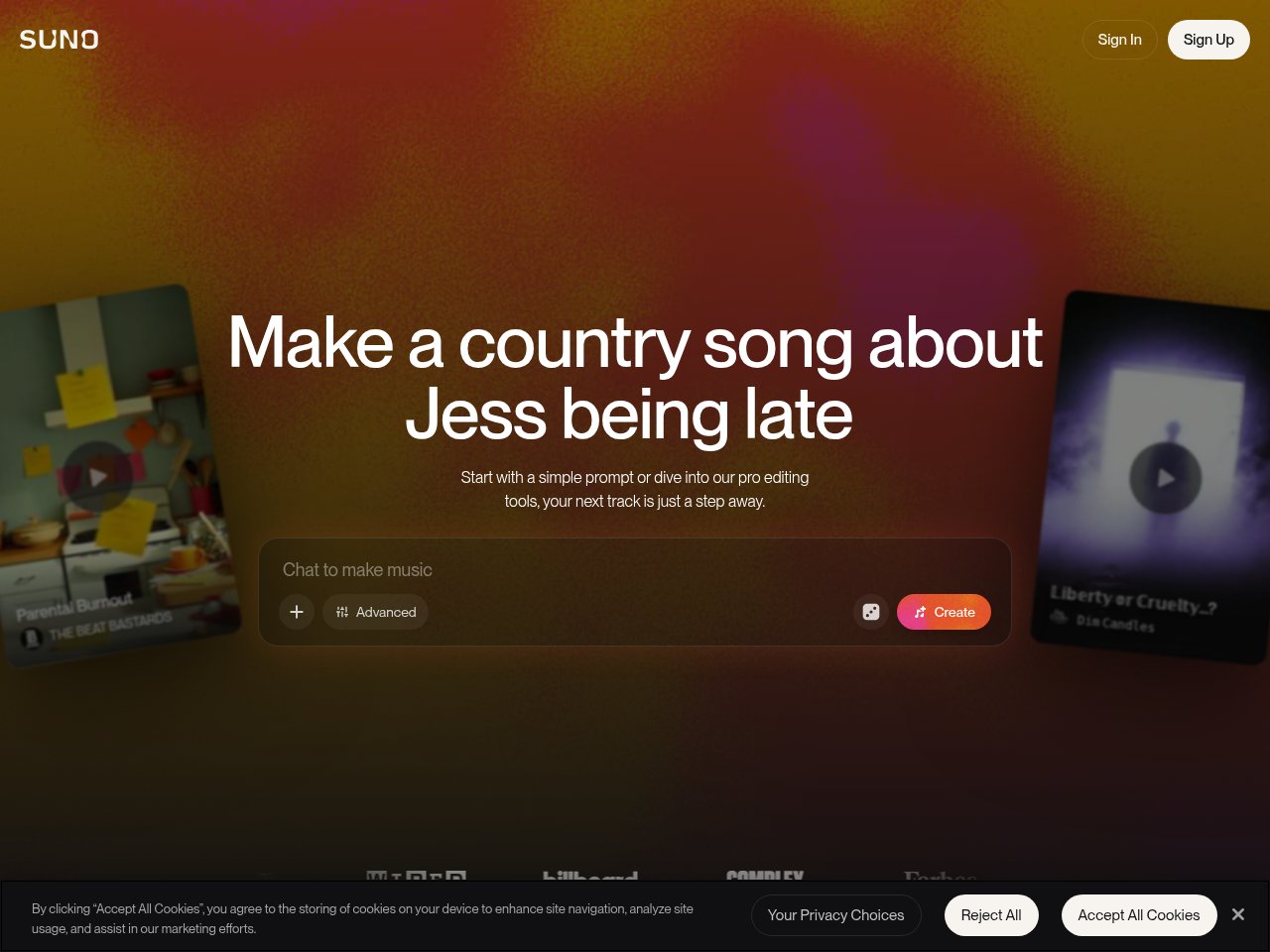
One-line verdict: If you want to type “sad country song about losing your Wi-Fi connection” and get a fully produced track with vocals in 30 seconds, Suno is your tool.
Suno blew my mind the first time I used it back in 2024, and somehow it keeps getting better. The current version generates complete songs — lyrics, vocals, instruments, mixing — from nothing more than a text prompt. And the quality? It is genuinely unsettling how good it sounds. I made a jazz ballad about my coffee addiction that my wife thought was a real song on Spotify.
The workflow is dead simple. You type a description (“upbeat 80s synth-pop about robots falling in love”), optionally paste your own lyrics, pick a style, and hit generate. Within 30-60 seconds you get two variations of a full song, usually around 2-3 minutes long. You can then extend tracks, create variations, or regenerate specific sections.
What blew me away:
- Genre versatility is insane — I successfully generated convincing hip-hop, metal, bossa nova, classical, K-pop, and that cursed polka-EDM hybrid. Suno handles them all.
- Custom lyrics work surprisingly well — paste in your own words and Suno matches the phrasing to the melody naturally. Not perfectly, but close.
- The free tier gives you 10 songs per day — that is legitimately generous for testing.
- Suno Studio (Premier tier) now functions as a full AI-native DAW with MIDI exports and multi-track editing.
Pricing:
- Free: 50 credits/day (about 10 songs), non-commercial, MP3 downloads
- Pro: $10/month ($8 annual) — 2,500 credits/month (~500 songs), commercial rights, Song Editor, stem extraction
- Premier: $30/month ($24 annual) — 10,000 credits/month (~2,000 songs), Suno Studio DAW, MIDI export, batch generation
What actually annoyed me:
Suno songs start sounding samey after a while. There is a recognizable “Suno sound” — a certain over-polished sheen and predictable song structures that trained ears will pick up immediately. The AI also struggles with complex time signatures (good luck getting a clean 7/8 prog rock track) and occasionally produces lyrics that sound like they were written by an AI pretending to be human pretending to be deep. Which, I suppose, is exactly what is happening. Also, free-tier songs belong to Suno — you have zero commercial rights until you pay.
Frankie’s verdict: Suno is the ChatGPT of AI music — not always the absolute best at one thing, but the best all-around package. If you are a content creator, YouTuber, or podcaster who needs custom music without hiring a composer, start here. The Pro plan at $10/month is genuinely excellent value.
2. Udio — The Audiophile’s Choice
One-line verdict: If Suno is the pop star, Udio is the indie musician with better taste and a cleaner mix.
Udio launched as the scrappy challenger to Suno, and in 2026 it has carved out a serious niche among people who actually care about audio quality. In my side-by-side tests, Udio consistently produced cleaner mixes with better separation between instruments. The vocals sound more natural — less of that uncanny-valley AI sheen that Suno sometimes has.
The generation process is similar to Suno: type a prompt, get a song. But Udio gives you a few more levers to pull. You can use reference audio to guide the style, inpaint specific sections you do not like (regenerate just the chorus, for example), and download individual stems (vocals, drums, bass, etc.) for remixing in your own DAW.
What blew me away:
- Audio fidelity is noticeably better — A/B testing against Suno, Udio wins on mix clarity about 60-70% of the time.
- Inpainting is a killer feature — regenerate just a specific section without redoing the whole song. Game-changer for iteration.
- Stem downloads — getting isolated vocals, drums, and bass tracks means you can actually remix and produce with this tool.
- 30-second extensions — build songs incrementally, one section at a time, for more control over structure.
Pricing:
- Free: 10 daily credits + 100 monthly backup credits (about 3 songs/day)
- Standard: $10/month — ~1,000 credits/month, no daily limits, commercial rights
- Pro: $30/month — ~4,800 credits/month, higher concurrency, priority generation
What actually annoyed me:
Udio’s interface feels like it was designed by engineers who forgot that normal humans use their product. The workflow is less intuitive than Suno’s, the generation sometimes stalls without clear feedback, and the community resources are thinner since it is a newer platform. Also, the free tier is stingier — 3 songs per day versus Suno’s 10. For a platform trying to compete with an established leader, that feels like a strategic mistake.
Frankie’s verdict: If you are a musician or audio professional who cares about mix quality and wants granular control, Udio is the better choice over Suno. If you just want quick songs for content, Suno’s ease of use wins. My recommendation: try both free tiers, generate the same prompt on each, and pick the one your ears prefer. You genuinely cannot go wrong with either.
3. ElevenLabs — The Voice & Audio Swiss Army Knife
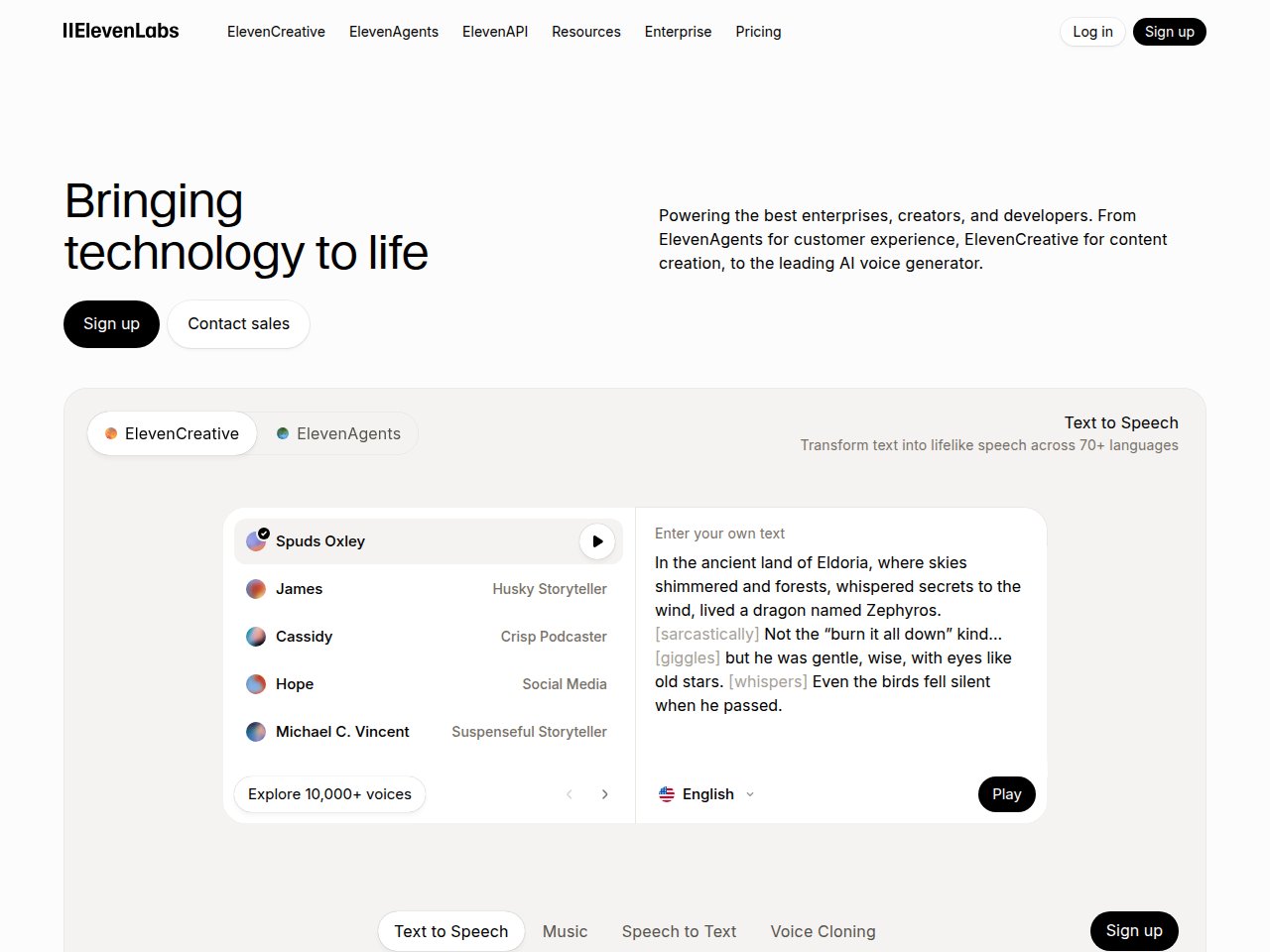
One-line verdict: ElevenLabs started with voice cloning and text-to-speech, then quietly became the most versatile audio AI platform on the planet.
Here is the thing about ElevenLabs that most people miss: it is not just a voice tool anymore. In 2026, it does text-to-speech, voice cloning, sound effects generation, music generation, dubbing, and audio isolation. It is the closest thing we have to an “everything audio” AI platform.
For this review, I focused on the music and sound effects capabilities alongside the voice features. The music generation is newer and not as mature as Suno or Udio for full songs, but the sound effects generator is the best I have tested anywhere. Type “medieval blacksmith hammering in a busy marketplace” and you get a layered, realistic soundscape that sounds like it came from a Hollywood foley studio.
What blew me away:
- Voice cloning quality is unmatched — 30 seconds of sample audio creates a clone that is frighteningly accurate. Languages, accents, emotions — it nails them all.
- Sound effects generation is best-in-class — 200 credits per generation, up to 30 seconds, and the quality destroys stock sound libraries.
- Text-to-speech is industry standard — there is a reason so many podcasts, audiobooks, and apps use ElevenLabs under the hood.
- Voice Design lets you create entirely new voices from scratch by describing the characteristics you want.
Pricing:
- Free: Limited credits, watermarked output, basic voices
- Starter: $5/month — 30,000 credits, 10 custom voices
- Creator: $22/month — 100,000 credits, full commercial rights, 100 voices
- Pro: $99/month — 500,000 credits, 500 voices, higher quality models
- Scale: $330/month — 2,000,000 credits, enterprise features
What actually annoyed me:
The credit system is confusing. Music, sound effects, TTS, and voice cloning all consume credits at different rates, and figuring out how much a project will cost requires a spreadsheet. The music generation specifically is still behind Suno and Udio for full song creation — it is better thought of as a sound design and voice platform that also does music, not a music-first tool. And $22/month for the Creator plan feels steep when Suno gives you 500 songs for $10/month. Different products, sure, but the price comparison is unavoidable.
Frankie’s verdict: ElevenLabs is not the tool to pick if all you want is AI-generated songs. But if you need a comprehensive audio toolkit — voice cloning for narration, sound effects for video, music for background, and TTS for accessibility — nothing else comes close. Game developers, video producers, and podcast creators should look here first.
4. Soundraw — The Content Creator’s Background Music Machine

One-line verdict: Soundraw does not generate songs from prompts — it lets you tweak AI-generated instrumentals bar by bar, which is exactly what video editors actually need.
Soundraw takes a fundamentally different approach from Suno and Udio. Instead of typing a prompt and hoping for the best, you select a mood, genre, instruments, and length, and Soundraw generates an instrumental track that you can then customize at the bar level. Want the energy to build in the first 15 seconds, peak at 0:30, and drop to a mellow outro? You can drag and adjust each section individually.
This might sound less exciting than “AI writes entire songs,” but for the actual use case most people have — needing background music for YouTube videos, podcasts, and presentations — Soundraw’s approach is arguably more practical.
What blew me away:
- Bar-level editing is genuinely unique — mute, solo, or adjust intensity for each section. No other AI music tool gives you this level of control.
- 100% original catalog — Soundraw generates everything from scratch, so there are zero copyright concerns. Period.
- Perpetual licensing — songs you create while subscribed stay licensed forever, even after you cancel.
- Stem exports available on Artist Pro plan for post-production flexibility.
Pricing:
- Creator: $9.99/month ($8.49 annual) — unlimited MP3 downloads, royalty-free for all content
- Artist Starter: $19.49/month — 10 downloads/month, streaming distribution rights
- Artist Pro: $23.39/month — 20 downloads, WAV files, stems included
What actually annoyed me:
There are no vocals. At all. If you need lyrics and singing, Soundraw is not the tool. The genre selection, while decent, is narrower than Suno or Udio — do not expect niche genres like Afrobeat or mathcore. The interface also has a learning curve. The bar-level editor is powerful but takes 20-30 minutes to really understand. And honestly, some of the generated tracks sound like stock music from a slightly better royalty-free library. It is good stock music, but it is still stock music.
Frankie’s verdict: Soundraw is the practical choice for video editors and content creators who need customizable background music with zero copyright risk. It is not glamorous, it will not generate viral TikTok songs, but it solves the “I need 2 minutes of upbeat background music for my YouTube video” problem better than anything else at $9.99/month.
5. Mubert — The Ambient Music Streaming Engine
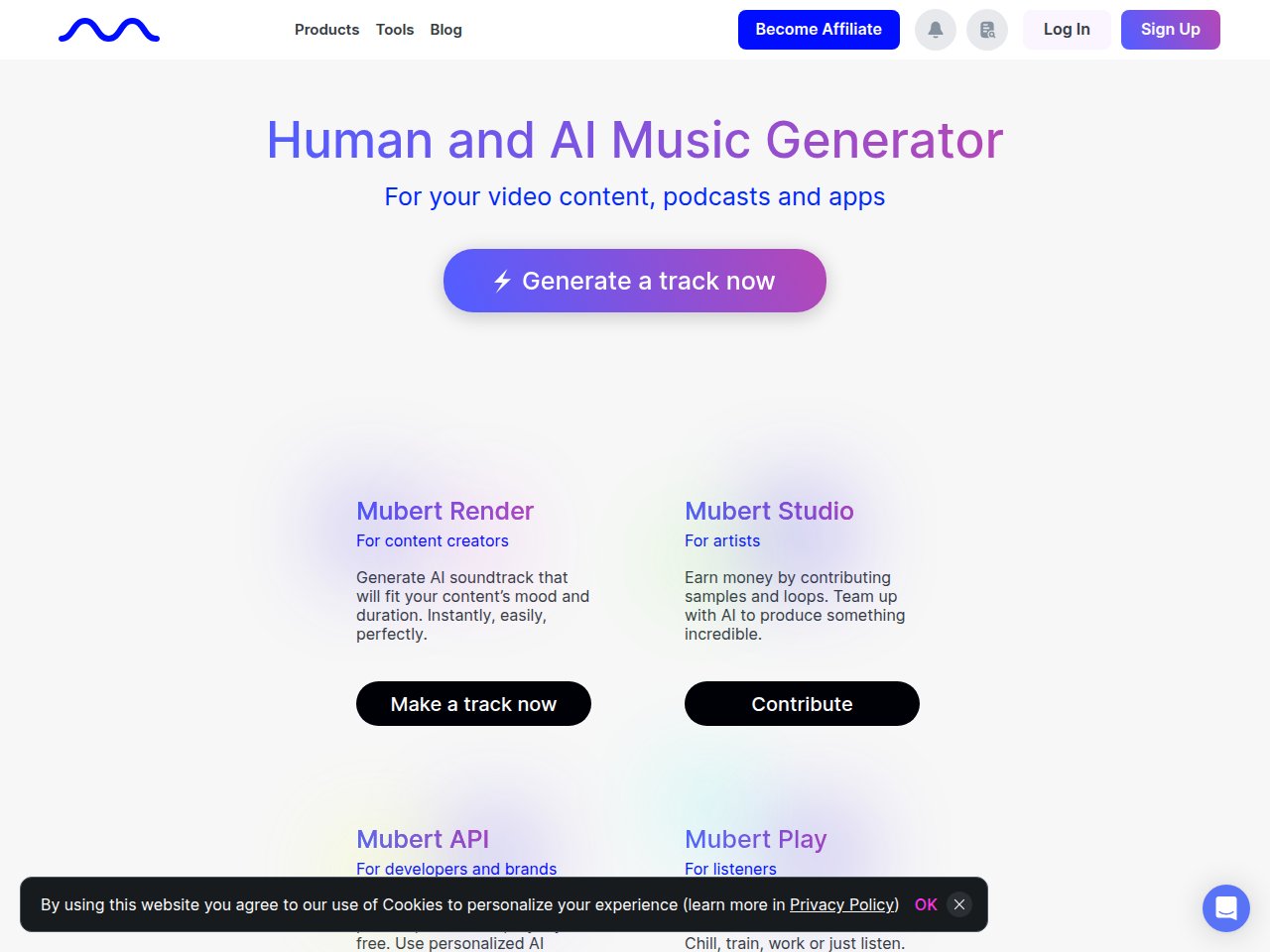
One-line verdict: Mubert generates endless streams of ambient, electronic, and lo-fi music in real-time — think of it as an AI DJ that never repeats itself.
Mubert is the weird one on this list, and I mean that as a compliment. While Suno and Udio generate discrete songs, Mubert generates continuous music streams that evolve and change in real-time. It was originally designed for apps, games, and environments that need non-repeating background audio — and for that specific use case, it is unbeatable.
You set parameters (mood, genre, intensity, duration) and Mubert generates a unique piece that literally never existed before and will never exist again. For streamers, meditation apps, focus music playlists, and in-store background music, this is exactly the right approach.
What blew me away:
- Real-time generative music — no waiting for generation. The music just flows.
- API for developers — integrate directly into apps, games, and websites for dynamic soundtracks.
- 25 free tracks per month on the Ambassador plan — enough to evaluate properly.
- Music built from real artist samples — Mubert collaborates with human musicians, which adds a layer of authenticity.
Pricing:
- Ambassador (Free): 25 MP3 tracks/month, attribution required
- Creator: $14/month — 500 tracks, lossless quality, no watermark
- Pro: $39/month — 500 tracks, full commercial rights including YouTube and ads
- Business: $199/month — 1,000 tracks, in-app music, account manager
What actually annoyed me:
Mubert is fantastic for electronic, ambient, and lo-fi genres but falls flat for anything else. Want a country song? A rock anthem? Forget it. The generation is limited to the sample library Mubert has built with its artist partners, so you are stuck in the electronic/ambient/chill universe. The Pro plan at $39/month feels expensive for 500 tracks when Suno gives you 500 songs for $10 (though they are different products serving different needs). Also, the single-track licensing prices are absurd — $99 for one track for YouTube ads? $499 for sublicensing? Come on.
Frankie’s verdict: Mubert is a specialist tool, not a generalist. If you need continuous, non-repeating background music for streams, apps, or ambient environments, it is the best option out there. For anything involving vocals, distinct songs, or non-electronic genres, look elsewhere.
6. Boomy — The “Anyone Can Be an Artist” Platform

One-line verdict: Boomy lets you generate a song, add AI vocals, and distribute to Spotify in under 10 minutes — it is the most frictionless path from idea to streaming platforms.
Boomy’s pitch is different from everyone else on this list. While Suno and Udio focus on generation quality, Boomy focuses on the full pipeline: create, customize, and distribute. You pick a genre (hip-hop, lo-fi chill, cinematic, etc.), Boomy generates a track, you tweak instruments, drums, tempo, and effects, optionally add vocals via their Auto Vocal tool, and then push directly to Spotify, Apple Music, and other streaming platforms.
The quality is not as impressive as Suno or Udio. Let me be upfront about that. But the zero-friction path to distribution is genuinely unique.
What blew me away:
- Auto Vocal tool — type lyrics and Boomy generates a full vocal line. Not as natural as Suno, but functional.
- Direct streaming distribution — Spotify, Apple Music, TikTok, YouTube Music, all built in.
- You own commercial rights to everything you create. Monetize wherever you want.
- Free tier lets you save 25 songs and release 1 to streaming platforms at no cost.
Pricing:
- Free: 25 song saves, 1 release (max 3 songs per release)
- Creator: $9.99/month — 500 song saves, 10 MP3 downloads/month, expedited review
- Pro: $29.99/month — unlimited saves, unlimited downloads, priority everything
What actually annoyed me:
The music quality is a clear step below Suno and Udio. Songs sound more generic and “AI-generated” in a way that is immediately recognizable to anyone who has spent time with these tools. The customization options, while decent, are surface-level compared to Soundraw’s bar-level editing. And there is an elephant in the room: Spotify and other platforms have been cracking down on AI-generated music, removing tracks and adjusting algorithms. Building a music career on Boomy-generated tracks feels like building a house on sand. Fun experiment? Absolutely. Sustainable strategy? Questionable.
Frankie’s verdict: Boomy is the gateway drug of AI music. It is the easiest way to go from zero to “I have a song on Spotify” and it is genuinely fun to play with. But if you care about quality or are building something serious, Suno and Udio are better tools. Use Boomy for the novelty and the distribution pipeline.
7. Adobe Podcast — The Audio Cleanup Wizard
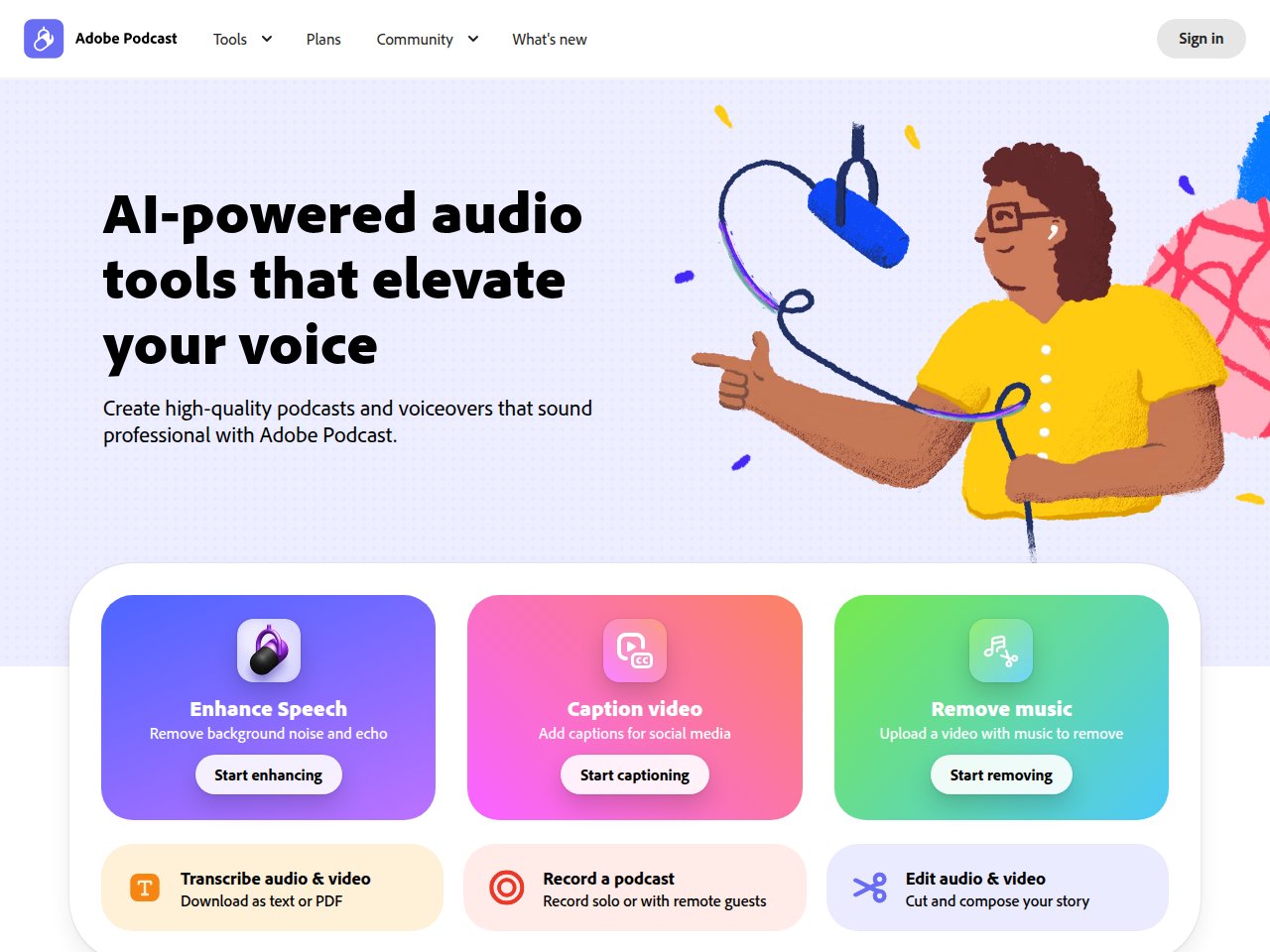
One-line verdict: Adobe Podcast is not a music generator — it is an AI audio enhancement tool that makes terrible recordings sound professional, and it does this better than anything else I have tested.
I know what you are thinking: “Frankie, this is a music generator roundup, why is a podcast tool here?” Because if you work with audio in any capacity, Adobe Podcast’s Enhance Speech feature will save you hours of manual cleanup. And that makes it essential for anyone in the music and audio space.
Upload a recording with background noise, echo, wind, keyboard clacking, your neighbor’s dog barking — whatever — and Enhance Speech strips it all away, leaving clean, studio-quality voice audio. I tested it with a recording I made in a coffee shop during peak hours. The result sounded like I recorded in a treated vocal booth. It was borderline witchcraft.
What blew me away:
- Enhance Speech is genuine magic — the noise removal quality exceeds dedicated plugins costing hundreds of dollars.
- Mic Check tests your setup before recording and suggests improvements. Super useful for beginners.
- Transcription-based editing (Premium) — edit audio by editing the transcript text. Delete a sentence from the text, and the audio edit happens automatically.
- Free tier gives 1 hour of daily processing — enough for most podcast episodes.
Pricing:
- Free: 1 hour/day Enhance Speech (30-min files, 500MB max), Mic Check, limited Studio access
- Premium: $9.99/month ($8.33 annual) — 4 hours/day, 2-hour files, 1GB, batch uploads, video support, unlimited downloads
What actually annoyed me:
It is not a music generator. I feel silly even mentioning this as a “con,” but in a roundup about AI music tools, it is worth noting that Adobe Podcast does not create music or generate anything — it only cleans up existing audio. The daily processing limits are annoying for power users (4 hours even on Premium). And the web-only approach means you cannot integrate it into a desktop DAW workflow without exporting and re-importing files. If Adobe integrated this into Audition or Premiere Pro natively, it would be unstoppable. As a standalone web tool, it is great but limited.
Frankie’s verdict: Every podcaster, YouTuber, and content creator should bookmark Adobe Podcast. The free tier’s Enhance Speech alone justifies its existence. It is not competing with Suno or Udio — it is complementing them. Generate your music with Suno, record your voiceover, clean it up with Adobe Podcast, done.
Head-to-Head Comparison: All 7 AI Music & Audio Tools
| Feature | Suno | Udio | ElevenLabs | Soundraw | Mubert | Boomy | Adobe Podcast |
|---|---|---|---|---|---|---|---|
| Primary Function | Full song generation | Full song generation | Voice + audio toolkit | Instrumental music | Ambient/electronic | Song creation + distribution | Audio cleanup |
| Vocals | Yes (AI-generated) | Yes (AI-generated) | Yes (cloned/TTS) | No | No | Yes (Auto Vocal) | Enhancement only |
| Free Tier | 10 songs/day | ~3 songs/day | Limited credits | No free tier | 25 tracks/month | 25 saves + 1 release | 1 hour/day |
| Cheapest Paid Plan | $10/month | $10/month | $5/month | $9.99/month | $14/month | $9.99/month | $9.99/month |
| Commercial Rights | Paid plans only | Paid plans only | Creator+ plans | All plans | Pro+ plans | All plans | N/A |
| Stem Downloads | Pro+ plans | Yes | N/A | Artist Pro only | No | No | N/A |
| Genre Range | Very wide | Very wide | Sound effects focused | 30+ genres | Electronic/ambient only | Limited selection | N/A |
| Audio Quality | Great | Excellent | Excellent | Good | Good | Decent | Excellent (cleanup) |
| Best For | Content creators | Musicians | Voice/audio pros | Video editors | Apps & streams | Aspiring artists | Podcasters |
| Frankie Rating | 9.2/10 | 8.8/10 | 9.0/10 | 7.8/10 | 7.5/10 | 7.0/10 | 8.5/10 |
What Actually Annoyed Me About AI Music in 2026
Let me get real for a second, because this is the stuff nobody in the “Top 10 AI Music Tools” articles wants to talk about.
The copyright situation is a mess. Suno and Udio were both sued by major record labels in 2024, and as of early 2026 those cases are still winding through courts. The legal question of whether AI models trained on copyrighted music can generate “original” output is unresolved. If you are using AI-generated music commercially, you are operating in a legal gray zone. Period. Suno and Udio both claim you own the output on paid plans, but that has not been fully tested in court.
Quality has a ceiling. After generating 50+ songs, the pattern becomes clear: AI music is great for background and functional music, but it cannot replace a skilled human musician for anything that requires genuine artistic vision, emotional nuance, or technical virtuosity. A Suno-generated jazz track sounds impressive for 30 seconds; a real jazz musician’s improvisation tells a story. We are not there yet.
The “anyone can make music” promise has a dark side. Streaming platforms are getting flooded with AI-generated tracks, which dilutes discovery for human artists and raises real ethical questions about the future of music as a profession. I love these tools, but I also worry about what they mean for working musicians.
My Recommended Stack (What I Actually Use)
After testing everything, here is the combination I settled on for my own audio workflow:
- Suno Pro ($10/month) — for generating custom background music for videos and podcasts
- ElevenLabs Creator ($22/month) — for voiceovers, sound effects, and voice cloning
- Adobe Podcast Free — for cleaning up any audio recordings (the free tier is enough for my needs)
Total cost: $32/month for a complete audio production toolkit. Three years ago, equivalent capabilities would have cost thousands in software, stock music licenses, and voiceover talent. We live in absurd times.
🔔 Stay ahead of the AI curve
Frankie drops honest AI tool reviews every week. No spam, no sponsored garbage — just tools that actually work.
FAQ
What is the best free AI music generator in 2026?
Suno offers the most generous free tier with 10 songs per day and surprisingly good quality. Udio gives about 3 songs per day for free. Both are worth trying to see which output you prefer. Keep in mind that free-tier songs on both platforms cannot be used commercially.
Can I use AI-generated music commercially on YouTube?
Yes, if you are on a paid plan. Suno Pro ($10/month), Udio Standard ($10/month), and Soundraw Creator ($9.99/month) all include commercial usage rights for YouTube, podcasts, ads, and client projects. Always check the specific terms of service, as they can change. Free-tier output typically cannot be used commercially.
Is AI-generated music copyrightable?
This is the million-dollar question with no clear answer yet. In the US, the Copyright Office has indicated that purely AI-generated content without meaningful human creative input may not be eligible for copyright protection. If you substantially modify, arrange, or curate AI output, your creative contribution may be protectable. Consult an IP attorney for your specific use case.
Suno vs Udio: which is better for music production?
Udio edges out Suno for pure audio fidelity and offers better tools for musicians (stem downloads, inpainting, reference audio). Suno is better for quick, easy generation with a more intuitive interface and more generous free tier. If you care about mix quality and want to remix in a DAW, choose Udio. If you want fast, good-enough songs for content, choose Suno.
Can AI music generators create songs in any genre?
Suno and Udio handle the widest range of genres — pop, rock, hip-hop, jazz, classical, country, EDM, metal, and many more. Soundraw covers 30+ genres but instrumentals only. Mubert is limited to electronic and ambient. Boomy covers mainstream genres. No tool handles every niche genre perfectly, but Suno and Udio come closest.
Will AI music generators replace human musicians?
Not anytime soon. AI music is excellent for functional purposes (background music, jingles, content soundtracks) but lacks the emotional depth, improvisational skill, and artistic vision of human musicians. The more likely outcome is that AI becomes a powerful tool that musicians use to enhance their workflow, similar to how digital recording did not replace musicians but changed how they work.
What is the cheapest way to get commercial AI music?
Boomy and Soundraw both start at $9.99/month with full commercial rights. Suno and Udio are $10/month for commercial tiers. For the best value considering output quantity, Suno Pro at $10/month gives you 500 commercially licensed songs per month, which is hard to beat.
Is ElevenLabs good for music or just voice?
ElevenLabs is primarily a voice and audio platform. Its music generation capabilities are newer and less developed than Suno or Udio. However, its sound effects generation is the best available, and the voice cloning, TTS, and dubbing features are industry-leading. Think of it as the best audio toolkit rather than the best music generator.
— Frankie