Interview with Hakob Astabatsyan, CEO of Synthflow AI
The co-founder of Synthflow talks about leaving BCG for voice AI, why they killed monthly pricing plans, and what happens when an AI agent goes completely off-script.
By Frankie|March 2026|10 min read
This interview has been edited for clarity and length.
Hakob Astabatsyan is the kind of founder who makes you question your life choices. The guy left a cushy strategy consulting gig at BCG, teamed up with his co-founders Albert Astabatsyan and Sassun Mirzakhan-Saky, and decided to build a no-code voice AI platform right when everyone was losing their minds over ChatGPT.
Fast forward to 2026: Synthflow processes over 40 million calls per month, raised $20M in Series A funding, and has over 1,000 customers globally. Their platform lets businesses deploy human-sounding voice agents without writing a single line of code. I’ve been testing it for weeks — and I had some questions. Pointed ones.
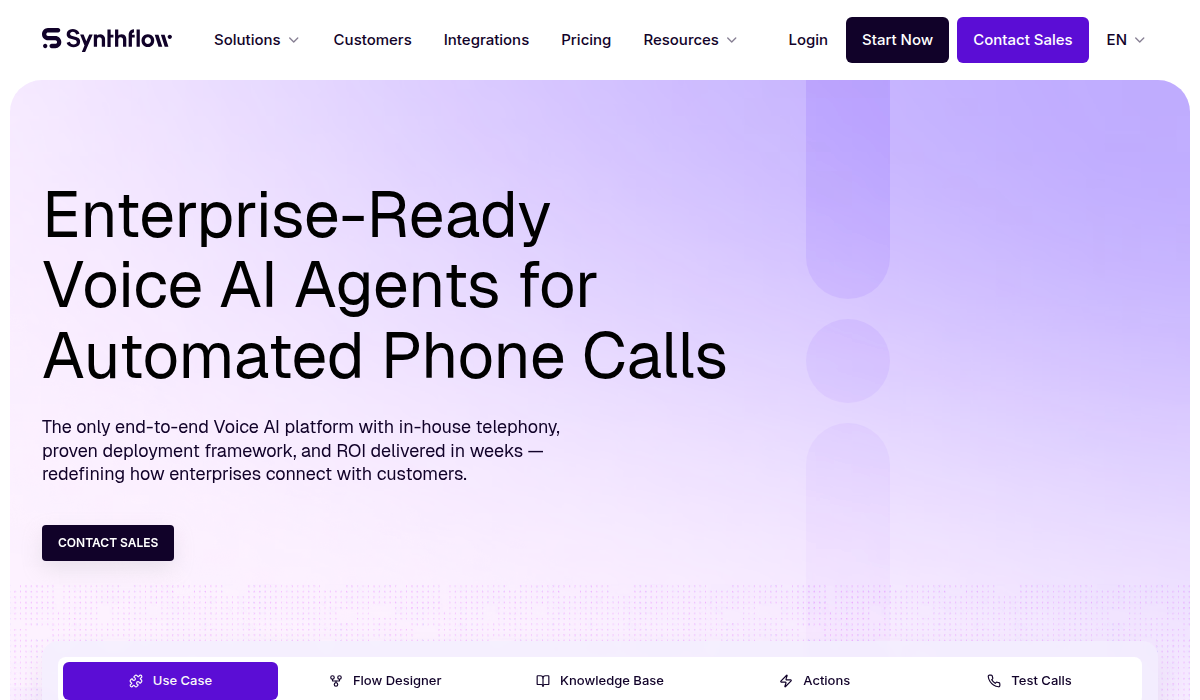
Synthflow AI homepage: Enterprise-ready voice AI agents for automated phone calls
Frankie: Alright Hakob, let’s start with the elephant in the room. You were at BCG — arguably one of the most prestigious consulting firms on the planet. What kind of brain malfunction leads someone to leave that for voice bots?
Hakob: Ha! I get that question a lot. Look, BCG taught me how to think about problems systematically, but I was always building things on the side. When OpenAI released GPT via API in early 2023, something clicked. I’d been in venture building at Rocket Internet before BCG, so the startup bug was already there. I saw the API and thought: “This changes everything about how businesses communicate.” Text chatbots were already everywhere, but voice — voice was the real frontier. And nobody was making it accessible.
Frankie: “Voice is the real frontier” — I’ve heard that from about 47 startups now. What made you think Synthflow could actually crack it?
Hakob: Fair point. The difference is we didn’t try to build the best AI model. We built the best deployment experience. When we started, if you wanted a voice AI agent, you needed a team of engineers, weeks of integration work, and a six-figure budget. We said: what if a dental office manager could set one up in an afternoon? No code, no engineering team, just drag-and-drop. That accessibility angle is what set us apart from day one.
Frankie: I tested your platform for three weeks. The setup was genuinely easy — I’ll give you that. But here’s my issue: when I threw curveball questions at the voice agent, it kind of… panicked. It kept looping back to the same scripted response. Felt more like a fancy IVR than an “intelligent agent.” What’s going on there?
Hakob: That’s a real challenge and I won’t pretend otherwise. Voice is inherently harder than text — latency, interruptions, timing — all of it matters more. When we launched, our response latency was over one second, which made conversations feel robotic. We’ve gotten it down to sub-500 milliseconds now, but handling off-script moments is still an active area of improvement. The key is constraining the agent’s scope. If it’s designed to schedule appointments, it shouldn’t try to answer questions about your refund policy. We’re building goal-driven agents, not general-purpose conversationalists.
Frankie: Let’s talk pricing because — man — you guys stirred up some drama. You killed the monthly plans ($29, $99, $449, $899) and went full pay-as-you-go. Some users on Reddit were NOT happy. “Bait and switch” was thrown around. What happened?
Hakob: I understand the frustration, and we could have communicated the transition better. But here’s the reality: fixed plans don’t work well for voice AI. A dental office making 200 calls a month and an insurance company making 20,000 calls a month have completely different needs. The old $29 plan gave you 50 minutes — that’s like 15 calls. Not useful for anyone serious. Pay-as-you-go at $0.13 to $0.24 per minute means you only pay for what you use. For most small businesses, that actually works out cheaper than the old Pro plan.
Frankie: $0.13 to $0.24 per minute — but that range is pretty wide. What determines where you land?
Hakob: It depends on three things: which LLM you choose (GPT-4 costs more than GPT-3.5), your telephony provider, and any add-ons like call recording or CRM integrations. We’re transparent about the components — you can see exactly what each piece costs before you deploy. And you can build and test agents completely free. You only pay when you go to production.
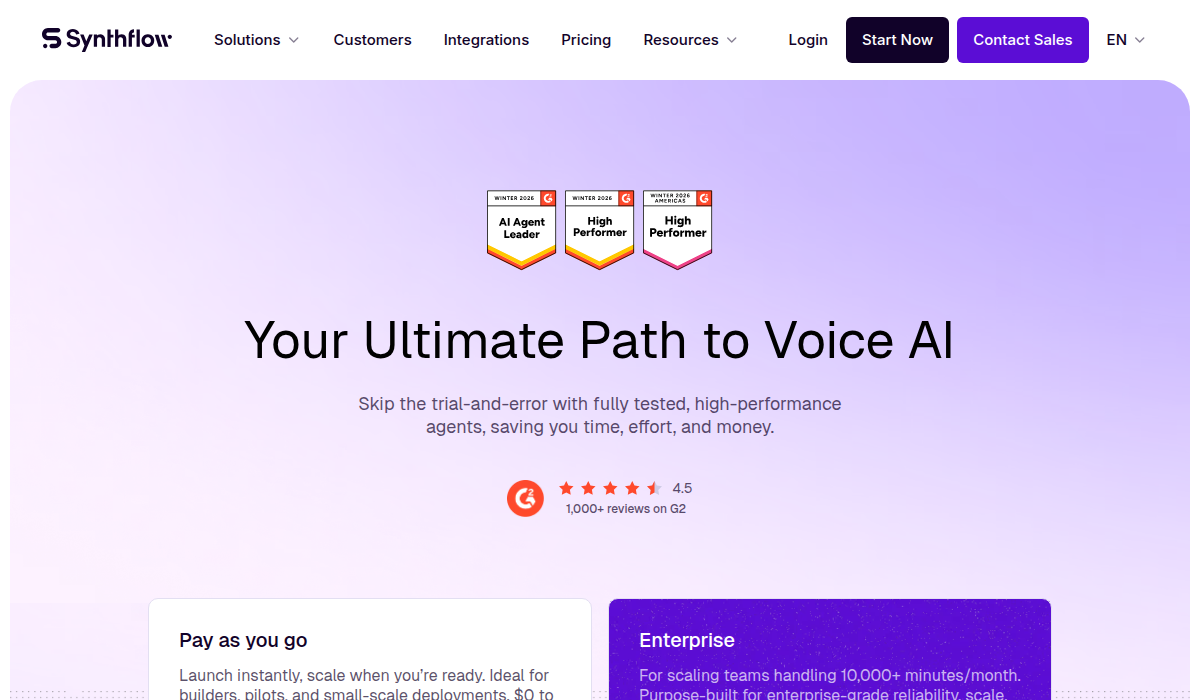
Synthflow AI pricing: Pay-as-you-go model starting at $0.13/minute
Frankie: I saw complaints about customer support too. People saying they can’t reach anyone, tickets going unanswered. For a company processing 40 million calls a month, that’s… ironic?
Hakob: [Laughs] Yeah, the irony isn’t lost on me. Look, we grew really fast — double-digit monthly growth since December 2023. Our support infrastructure didn’t scale as fast as our customer base. We’ve tripled our support team in the last six months and built a dedicated success team for enterprise accounts. I won’t claim we’re perfect now, but we take this seriously. A voice AI company that can’t communicate with its own customers is a bad look.
Frankie: You’re based in Berlin, which is unusual for this space. Most voice AI startups are in SF. Is that a disadvantage?
Hakob: Honestly, it’s been an advantage. We’re one of the very few European-based AI assistant vendors, which gives us a natural edge with EU customers who care about GDPR compliance. We’re SOC 2, GDPR, and HIPAA certified. Try finding that combination in the Y Combinator batch startups. Also, Berlin’s talent pool for AI and engineering is seriously underrated.
Frankie: You mentioned hallucination prevention earlier. How do you stop an AI voice agent from making stuff up on a live phone call? That seems like a nightmare scenario.
Hakob: It’s our biggest technical challenge. Our approach is constraint-based: agents operate within a defined knowledge base and specific task parameters. If an agent is designed to schedule calls, it simply won’t respond to unrelated prompts. It’ll politely redirect or offer to transfer to a human. We also add subtle human cues — pauses, filler words like “let me check on that” — which buy time for processing and make the conversation feel natural rather than robotic.
Frankie: What’s the most creative use case you’ve seen from a customer?
Hakob: A property management company in Texas set up agents that handle maintenance requests. Tenants call, describe the issue — “my kitchen sink is leaking” — and the agent categorizes the urgency, checks contractor availability, and schedules a repair, all in one call. They went from a 48-hour response time to under 2 hours. That’s the kind of use case that gets me excited — not replacing humans, but eliminating the annoying wait times that frustrate everyone.
Frankie: “Not replacing humans” — come on, Hakob. You’re literally automating phone calls. Some human was doing that job before.
Hakob: You’re right, and I should be honest about it. The receptionist who was spending 6 hours a day answering the same 10 questions — yes, that role changes. But what we see in practice is that our customers redeploy those people to higher-value work. The dental office receptionist stops answering “what are your hours?” 50 times a day and spends more time on patient care. We’re not here to flood people with spam or take jobs away. The future of customer communication is like a relay — the AI runs the first leg, handles the routine stuff, and passes the baton to a human for anything that requires empathy or complex judgment.
Frankie: Competitive landscape — Bland AI, Retell AI, Vapi — there are a LOT of players now. What keeps you up at night?
Hakob: Honestly? Not any single competitor. What keeps me up is making sure we don’t lose our focus on accessibility. It would be easy to chase enterprise features and forget the small business owner who just wants their phone answered after hours. The market is big enough for multiple winners, but I think the company that makes voice AI as easy as setting up a Gmail account is the one that wins long-term.
Frankie: What’s coming in the next 6-12 months?
Hakob: Big things. Persistent memory across calls — so if a customer called last week, the agent remembers the context. Real-time analytics dashboard so businesses can see exactly how their agents are performing. Multi-location call routing for franchise businesses. And WhatsApp call support, which is massive for international markets. We’re also building custom performance evaluations so you can grade your agent like you’d grade an employee.
Frankie: Last question. You’ve raised $20M+, you’re processing millions of calls, you left a prestigious career. Any advice for founders who are thinking about jumping into AI?
Hakob: Don’t build an AI wrapper. Seriously. If your entire product is a nice UI on top of someone else’s API, you’re one API update away from irrelevance. Find a specific problem, go deep, and build real infrastructure around it. Also — and this sounds cliché but it’s true — the idea that you need a technical co-founder is overblown. What you need is someone who’s obsessively focused on the customer’s problem. The tech will follow.
Frankie’s Take
I went into this conversation ready to grill Hakob about support horror stories and pricing drama, and he… didn’t dodge. The guy admitted their support infrastructure lagged behind growth, acknowledged that voice agents still struggle with off-script moments, and was honest about the job displacement question. That’s refreshing in a space where every founder claims their AI is “revolutionary” and “game-changing.”
Synthflow’s real strength isn’t the AI itself — it’s the deployment experience. Getting a voice agent live in under two weeks without engineers is genuinely impressive. But they need to close the gap on conversation quality. When your bot loops back to the same scripted response during a curveball, users notice. The sub-500ms latency is great; the intelligence needs to catch up.
The pricing pivot to pay-as-you-go makes sense on paper, but the communication was botched. If you’re going to change your entire pricing model, you’d better have a migration plan that doesn’t leave early adopters feeling burned. That said, for new users, the pay-per-minute model is actually more fair than the old “50 minutes for $29” approach.