The serial entrepreneur behind Pictory talks about leaving enterprise software for AI video, why hackathon prototypes sometimes become real companies, and the hard truth about AI-generated B-roll.
By Frankie|March 2026|10 min read
This interview has been edited for clarity and length.
Vikram Chalana has the kind of resume that makes you do a double-take. Research scientist turned enterprise software founder (Winshuttle, 300+ employees, 200x revenue growth), turned AI video startup CEO. The guy arrived in Seattle from India on a scholarship at 21, got a PhD, and has been building companies ever since.
Pictory turns your blog posts, scripts, and long-form content into short videos using AI. Sounds simple. It’s not. I tested it extensively, and while the ease-of-use is genuinely impressive, the AI’s ability to match visuals to content context is… well, let’s talk about it.
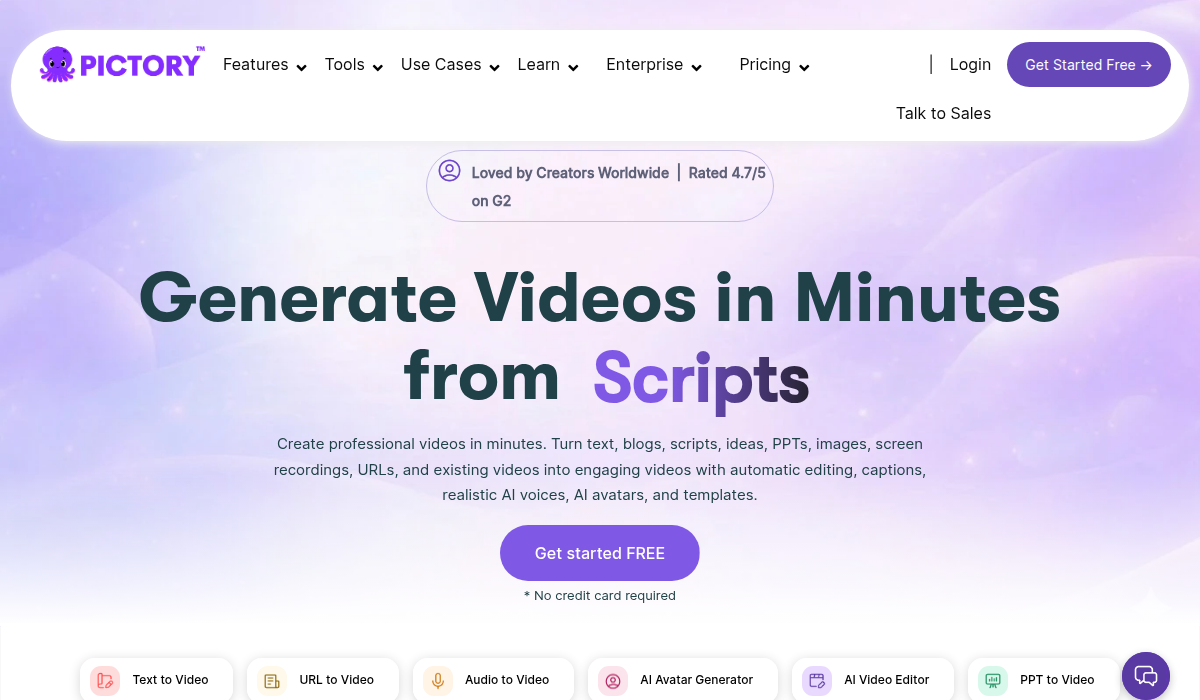
Pictory AI homepage: Generate videos in minutes from scripts, blog posts, and more
Frankie: Vikram, you built Winshuttle from 4 people to 300+, with 200x revenue growth. That’s a massive success story. Why on earth would you leave that to make an AI video tool?
Vikram: Great question. After 15 years at Winshuttle, I felt I’d taken it as far as I could personally. But the real trigger was a communication problem we had internally. We had teams distributed across time zones — Seattle, India, Europe — and we struggled to create engaging video content for training and updates. Neither I nor my co-founder Abid Ali had video production skills, and hiring external companies was expensive, slow, and inflexible. We kept thinking: there has to be a better way.
Frankie: And that “better way” started at a hackathon?
Vikram: Exactly. In 2019, Abid and I entered a hackathon in Seattle with a prototype that could convert a blog post into a rough video. People went crazy for it. We realized we’d stumbled onto something much bigger than an internal tool. We spent 2020 building it out properly, and launched the first version of Pictory in July 2020. The timing was perfect — COVID had everyone creating content remotely and video demand exploded.
Frankie: Okay, I need to be honest with you. I tested Pictory pretty thoroughly, and the visual matching is… problematic. I wrote a paragraph about email “open rates” and Pictory showed footage of people opening physical mail. I mentioned “deliverability” and got delivery truck footage. That’s jarring.
Vikram: [Laughs] I’ve seen that exact example, and you’re absolutely right — it’s one of our biggest challenges. AI visual matching is essentially a context problem. The AI sees “open” and thinks physical opening. It sees “delivery” and thinks logistics. We’ve made huge improvements with our latest models, but marketing and tech terminology still trips up the system. Our recommendation is to always review and swap out mismatched clips manually. It takes 5 minutes and the result is dramatically better.
Frankie: “Just fix it manually” is a tough sell when your whole pitch is “AI does it for you.” How do you square that?
Vikram: I think the value proposition is time compression, not perfection. Creating a video from scratch takes 3-5 hours even for experienced editors. Pictory gets you 80% there in 10 minutes. Spending another 5-10 minutes swapping a few clips is still a massive time savings. We’re not replacing Adobe Premiere — we’re replacing the scenario where you never make the video at all because it’s too much work.
Frankie: Let’s talk about those AI voiceovers. Users report they sometimes sound robotic and mispronounce technical terms. “Kubernetes” apparently comes out sounding like a Greek philosopher.
Vikram: Pronunciation is genuinely hard for AI voices, especially with technical jargon, brand names, and acronyms. We support 29 languages on our Professional and Teams plans, and each language has its own quirks. We’ve added a pronunciation editor where you can phonetically spell out tricky words, but I agree it should work better out of the box. This is an area where the underlying TTS technology is improving rapidly — what sounded robotic six months ago sounds natural today. We’re upgrading our voice engine continuously.
Frankie: Your pricing is $19/$39/$99 per month. But users complain that the good features are locked behind higher tiers. The Starter plan feels like a demo.
Vikram: The Starter plan is designed for individuals creating basic content — 30 videos a month with standard voices. For professional use, yes, you need the Professional plan. That’s not unusual in SaaS. What I think we do well is the free trial — you can create three full projects, up to 10 minutes each, with full features. That’s enough to genuinely evaluate whether Pictory works for your use case. Most video tools give you 30 seconds or nothing.
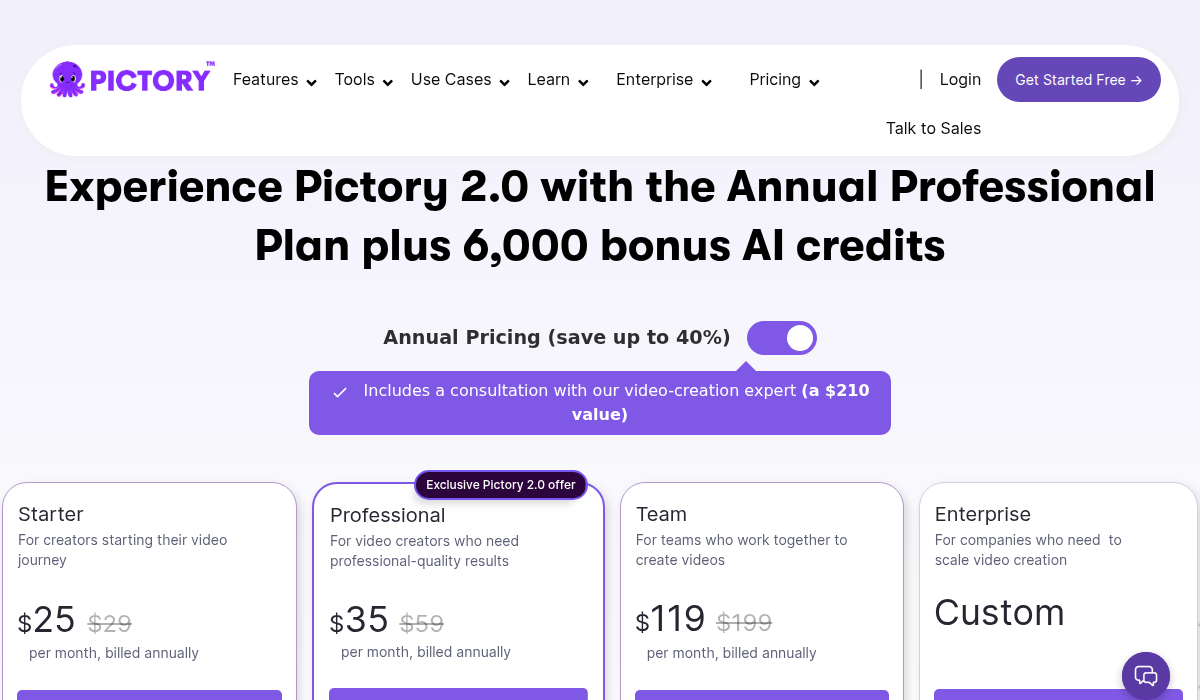
Pictory AI pricing: Plans starting from $25/month (Starter) to $119/month (Teams)
Frankie: No mobile app in 2026. In a mobile-first world. Why?
Vikram: It’s a prioritization decision. Our users primarily create content at their desks — marketers, content teams, course creators. They’re working with scripts, blog posts, editing on a full screen. A mobile app for quick social media clips is on our roadmap, but building a good mobile video editing experience is a massive engineering effort. I’d rather do it right than rush out something mediocre. That said, I hear the feedback and it’s moving up our priority list.
Frankie: You’ve been in tech for over 25 years. How is building an AI startup in 2026 different from building an enterprise software company in 2003?
Vikram: Night and day. When I started Winshuttle, we acquired existing technology and built on it. Sales cycles were 6-12 months. Customer acquisition cost was enormous. With Pictory, a user signs up, creates a video in 15 minutes, and decides within a week if they’re staying. The feedback loop is incredibly fast. But the flip side is that competition is brutal. In 2003, if you had a working product, you had maybe 3-4 competitors. Now, a new AI video tool launches every week. Speed of innovation is everything.
Frankie: Speaking of competition — Synthesia, InVideo, Lumen5, Descript — the AI video space is packed. What’s Pictory’s moat?
Vikram: Our moat is the text-to-video workflow. Most competitors start from templates or stock footage. We start from your existing content — blog posts, articles, webinar transcripts — and transform it into video. That’s a specific use case where we’re genuinely best-in-class. A marketer who publishes 4 blog posts a week can turn each one into a month’s worth of social content using Pictory. That content repurposing angle is our sweet spot.
Frankie: $3.9M revenue with a 57-person team. Those are lean numbers. Intentional?
Vikram: Very intentional. I learned at Winshuttle that growing headcount too fast creates more problems than it solves. We focus on efficiency. Our engineering team in India is incredibly talented, and the Seattle team handles product and strategy. We’re profitable at unit economics level, which means we’re not burning through venture money just to show growth. Sustainable beats flashy every time.
Frankie: What’s coming next for Pictory?
Vikram: Better AI visual matching — that’s priority number one based on user feedback. More natural-sounding voices with emotional range. A streamlined batch processing workflow for teams creating content at scale. And yes, eventually a mobile companion app for quick edits and social publishing. We’re also exploring AI-generated custom visuals instead of relying solely on stock footage, which would solve the context-matching problem at its root.
Frankie: You came to the US on a scholarship at 21, built a 300-person company, and now you’re doing it again. What advice would you give to immigrant founders?
Vikram: Don’t wait for permission. The biggest advantage immigrant founders have is that we’ve already taken the biggest risk — leaving everything familiar behind. After that, starting a company feels comparatively small. Also, don’t try to start with a blank page. At Winshuttle, we acquired existing technology. At Pictory, we built our prototype at a hackathon. Start with something tangible and iterate. The perfect plan is the enemy of the working product.
Frankie’s Take
Vikram has that rare combination of serial entrepreneur experience and genuine technical humility. He didn’t try to BS me when I brought up the visual matching problems or the robotic voiceovers. He acknowledged the issues, explained the tradeoffs, and pointed to specific improvements in the pipeline. That credibility matters.
Pictory’s value prop is real: turning blog posts into videos fast is something content marketers genuinely need. But “80% done in 10 minutes” means you still need to manually fix the other 20%, and for non-technical users, that editing experience needs to be smoother. The clunky preview loading and limited editing tools are the weak links.
What impressed me most was the financial discipline. $3.9M revenue with 57 people, focusing on sustainable growth over venture-funded blitz scaling? In the AI gold rush, that kind of restraint is either brilliant or quaint. Given Vikram’s track record of building a 300-person company from scratch, I’m betting on brilliant.